ART DIRECTION / TOOLS / ITERATION
From concept to expression.
From color to surface.
Shaping AI around our production process.
A custom ComfyUI workbench connects references, iteration, comparison and game-ready output.
Work: · Journal: · Times in EDT (UTC−04:00)
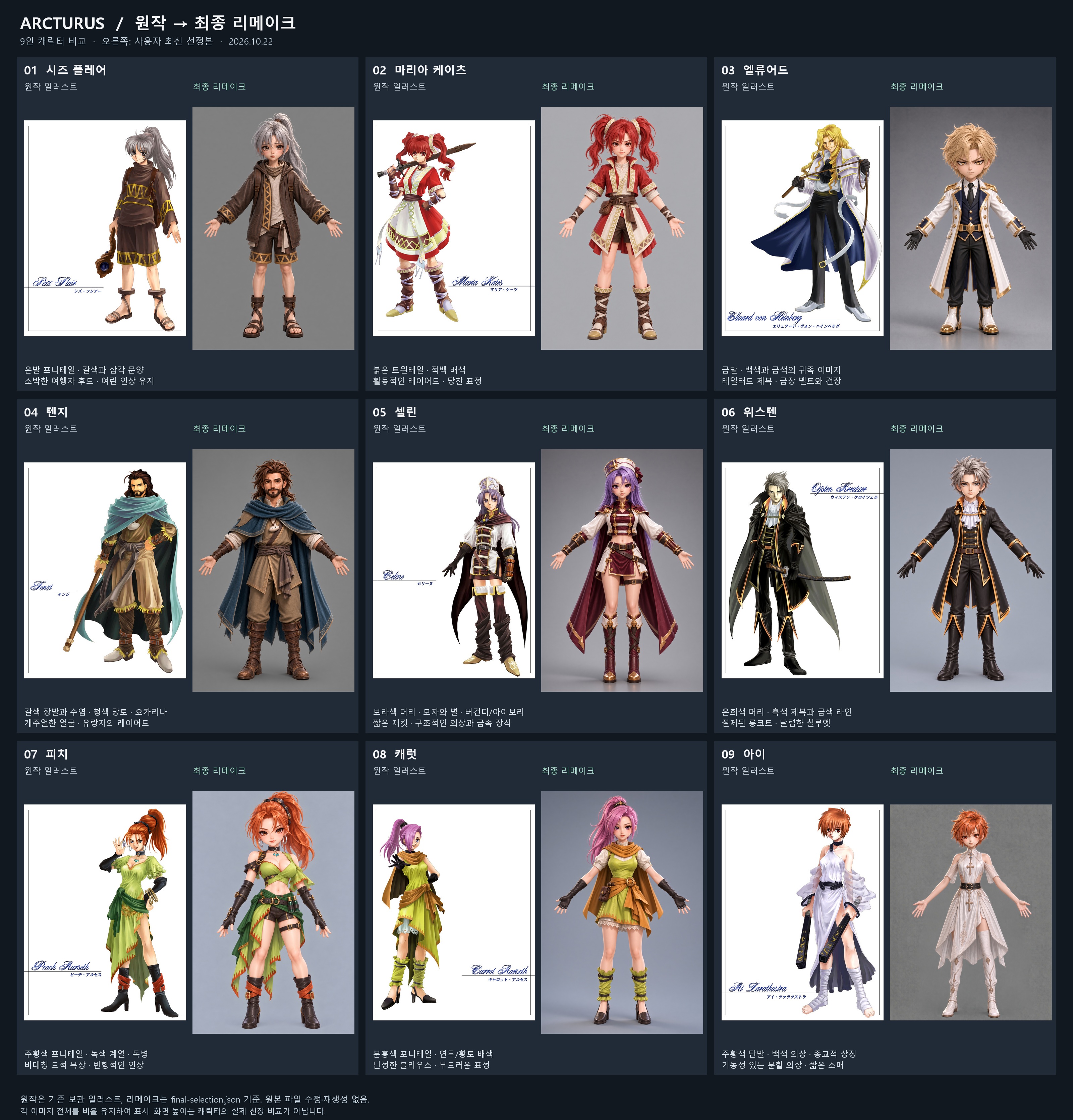
Original → selected concept. Open the image for full resolution. Display heights are aligned; this is not a physical height comparison.
01 / CHATGPT · OPENAI IMAGEGEN
Finding the familiar, one character at a time
Original illustrations anchored hair, palette and costume identity; approved quality references guided proportions and material treatment. The initial 3.5-head direction evolved toward a roughly 4.5-head stylized silhouette. These are art-direction targets, not measured proportions.
Designed for the move into 3D
The concepts were restructured for AI-assisted modeling and animation. Front-facing full-body poses, separated arms and fingers, and a low A-pose expose forms for modeling. Cape and skirt overlap and oversized sleeve lengths were reconsidered to simplify skinning and reduce clothing intersections during movement. Rigging and animation will test those choices.
What feedback changed
- Sizz — from an ornate mage outfit back to a modest traveler's hood and brown triangular motif.
- Maria — a confident expression and active silhouette that contrast with Sizz.
- Tenzi — less weathering, with the cape, ocarina and softer impression restored.
07:25 Celine → 07:39 Sizz → 09:16 Maria. Tenzi was iterated between 09:44 and 10:49, followed by proportion and style alignment between 13:02 and 13:13. The latest final-selection record was saved at 16:10:50. These are file-save timestamps, not API execution times.
The recorded engine is OpenAI built-in imagegen; its internal model version was not exposed. The final nine also include user-supplied images, so not every selected image has verified model and prompt provenance.
02 / COMFYUI · FLUX 3 · CHARACTER LoRA R&D
Nine characters. Thirty-four performances.
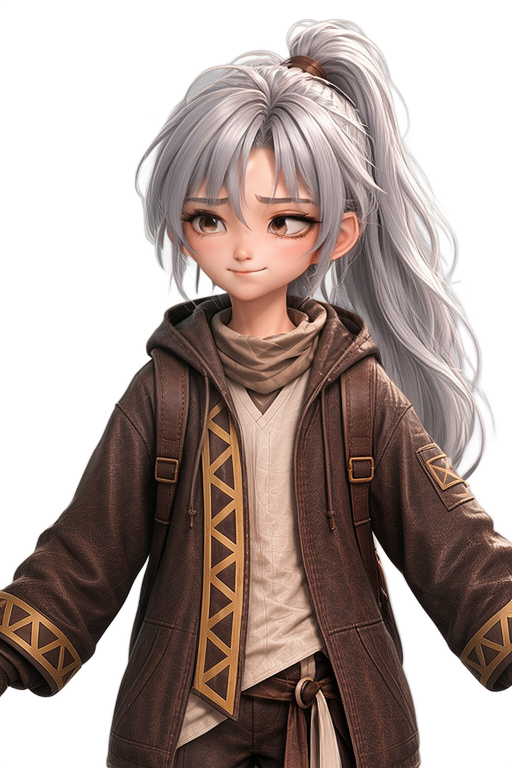
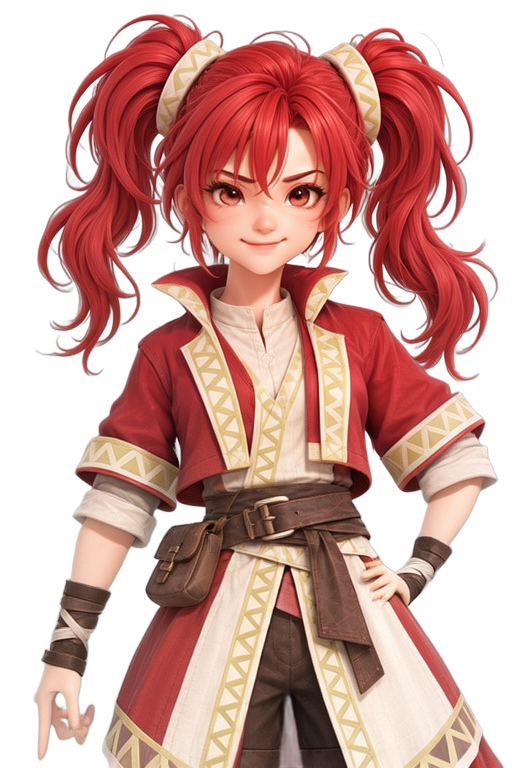
The selected full-body image stays the identity reference while emotion and acting poses vary. Arms can relax, fold across the body or move toward the chin or chest, creating gestures suited to conversation.
Our custom ComfyUI workbench uses FLUX 3 for this reference-based production. Character LoRAs are also being developed and refined to strengthen consistency across faces, hair and costumes. This is ongoing development; the existing 34 slots are not presented as LoRA-trained results.
The first 34 slots were followed by 10 revisions and another 3. Cropped heads or hands, unintended winks and sadness that did not read clearly prompted another review. The final set contains 9 characters and 34 expression slots.
| Character | Slots | Character | Slots | Character | Slots |
|---|---|---|---|---|---|
| Sizz | 7 | Maria | 8 | Elluard | 3 |
| Tenzi | 4 | Celine | 4 | Wysten | 2 |
| Peach | 3 | Carrot | 2 | Ai | 1 |
The first batch began at 16:56:22; the last v3 revision began at 17:29:27. The receipts record 34+10+3 generation calls, excluding separate pilots.
ComfyUI workflow: character-remake-flux3. Receipt model: FLUX 3 Image Klein Base. Native 512×768 output, without upscaling. CPU rembg / isnet-general-use added alpha while preserving the original RGB. All 34 slots were subsequently approved for prototype use, with further refinement during integration.
Compare all 34 original and new portraits ↗03 / COMFYUI PILOT → GROK IMAGINE
Keeping the geometry, reworking the surface
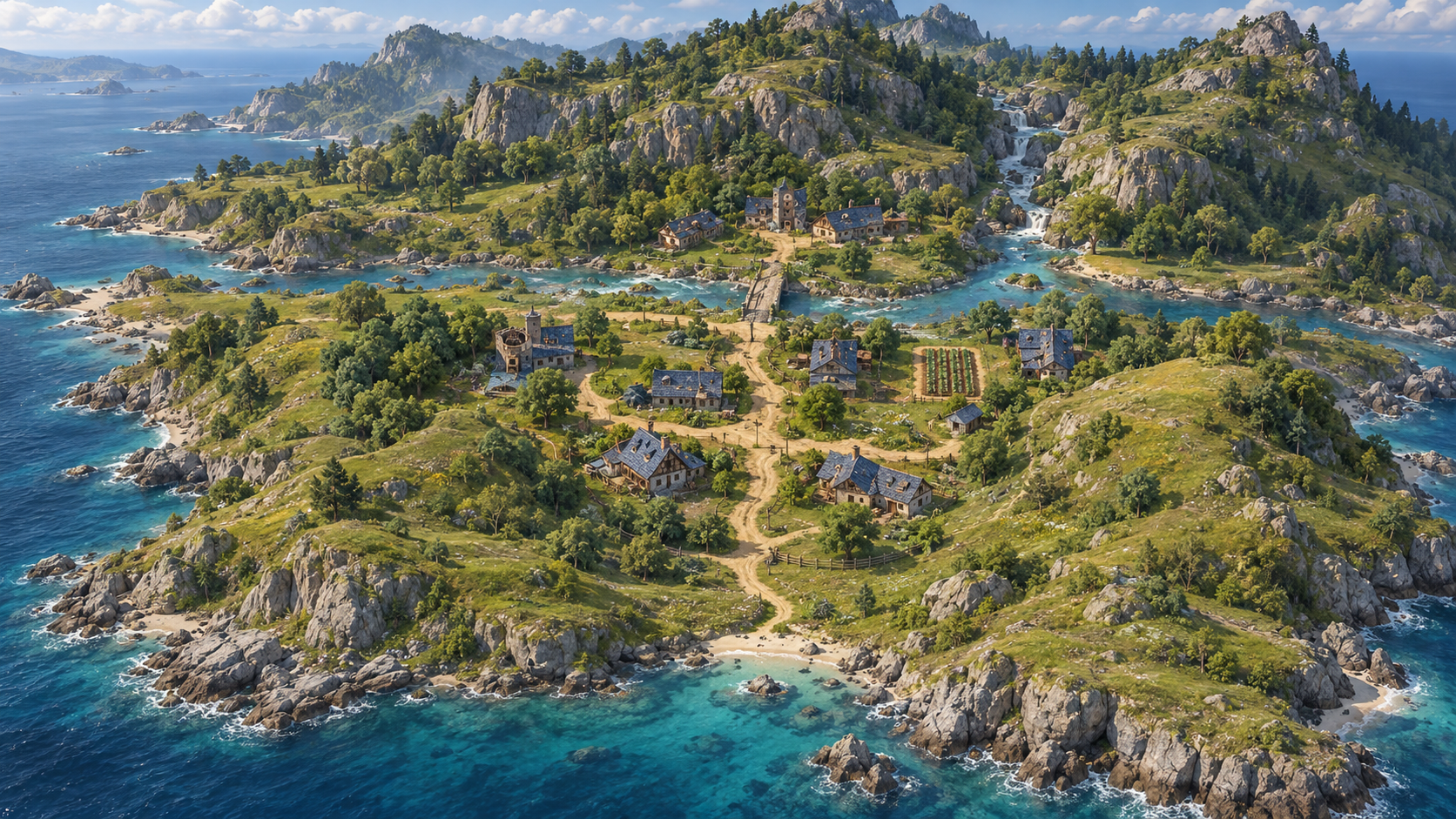
The first test was a 256×128 roof texture. A dedicated FLUX workflow removed character-specific settings and produced 1024×512 candidates. Unwanted lettering and overly long prompts led to a simpler request.
Grok was then connected through the same Nourish workbench. The original texture supplied the UV layout; an approved roof supplied color and material style. Keeping those roles separate was essential to avoid borrowing the reference image's layout.
Redesign this roof tile texture as a high-quality Unreal Engine game texture. Preserve the original UV layout
The actual first Grok roof prompt from October 22. “Unreal Engine” describes the intended visual finish; it does not mean the image was rendered in Unreal.
After BaseColor
The generated color image became the input for Height, Normal and Roughness requests. Instructions specified OpenGL +Y normals and white for rough surfaces, black for smooth surfaces.
Issues still under review
Style references sometimes turned wood into brick or shifted window placement. Some roughness outputs resembled height or AO. These are generated interpretations, not physically measured or baked material maps.
The first Grok roof generation used grok-imagine-image-2.0, with native output at 2912×1456. A later batch of 77 targets started at 21:22; its 22:36 snapshot showed 41 completed sets. That snapshot does not establish completion of all 77.
04 / PREPARE · APPLY · REVIEW
Turning generated images into usable assets
Originals and raw generations were preserved while game-ready copies were prepared. The default longest edge was capped at 2048, with original aspect ratios and no unnecessary upscaling. Short strips were repeat-padded and cropped to align the same tile region across maps.
- Restore alpha — apply the original cutout mask with nearest-neighbor sampling.
- Prepare channels — Height and Roughness as 8-bit single channels; Normal as RGB8, renormalizing vectors after resizing.
- Keep names consistent — group color, height, normal and roughness around the original BMP name.
- Review in Unity — apply to the original mesh and UVs, then compare surfaces, seams and lighting response.
The October 23 Unity record covers 33 PBR sets, 34 prefabs and 241 material slots. Generation progress and game-integration counts describe different stages and snapshots. Strong wood reflections and existing window UV seams remain follow-up items.